Safe pyrotechnics
December 23, 2020
Even the smallest pyrotechnic "toys" are far from harmless. They consist of gunpowder, special additives, and a certain amount of metal. The height of the spark stream (glowing metal particles) can reach 50-60 centimeters. If they fall on synthetic materials or paper, they can cause ignition.
Even the smallest pyrotechnic "toys" are far from harmless. They consist of gunpowder, special additives, and a certain amount of metal. The height of the spark stream (glowing metal particles) can reach 50-60 centimeters. If they fall on synthetic materials or paper, they can cause ignition.
Therefore, it is strongly not recommended to use them indoors or in crowded places. Their use is permitted only in open areas, far from residential buildings and structures.
Bengali sparklers burn at a temperature of 1000 degrees, and the radius of flying sparks can exceed one meter. The most dangerous pyrotechnic products sold are single fireworks and firework batteries, with a dangerous zone radius of 20 meters. They are the source of flames and scattered fire hazardous elements. If an unburnt residue of a pyrotechnic element falls on combustible material, it can lead to a fire or burn.
So, how can you celebrate the holidays cheerfully and safely?
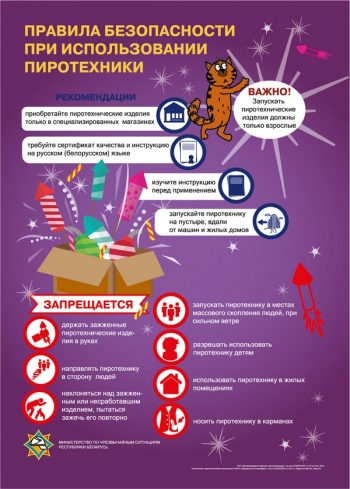
1. Purchase. First of all, forget about pyrotechnic products bought "under the counter"; purchase them only from specialized retail outlets. Do not agree to more favorable offers – your eyes and hands are worth more in case of an emergency. Do not skimp on safety! Ask the seller for a certificate. Pay attention to the expiration date (as a rule, pyrotechnics are stored for no more than three years) and the instructions (must be in Belarusian or Russian). Examine the packaging and the product itself: there should be no defects or dents, and the fuse should be sealed or hidden under the wrapper.
2. Storage. The storage area must be dry and free from any sources of fire, and pyrotechnics should not be kept near heating radiators. For example, a balcony or kitchen is not suitable as a storage place: the product will either get damp and, in the best-case scenario, will not
will work, or in the worst-case scenario, it will detonate at the most inconvenient moment. Or vice versa, it will detonate spontaneously as it gradually heats up.3. Launch. The most critical moment is when the pyrotechnics are in action. Before launching, be sure to read the instructions again, as each product has its own specifics; be attentive. Only sparklers, party poppers, and cake candles can be used indoors (without losing vigilance) – all other pyrotechnics belong outdoors.
It is also not advisable to set off fireworks from a balcony. An open area is required for launching pyrotechnics. An important condition is calm weather. The distance to buildings, power lines, vehicles, and people – all of this is described in the instructions for the specific product. The fuse should be ignited at arm's length. Do not aim fireworks at spectators.
If the pyrotechnics do not work, you must follow these rules.
1. Ensure that the fireworks will not detonate by waiting 10-15 minutes at a safe distance. If nothing happens after this time, you can approach the fireworks.
2. Inspect and ensure there are no smoldering parts of the fireworks. If there is no smoldering, you can proceed with further actions. If there are smoldering parts, immediately move away from the fireworks to a safe distance. Such a product still poses a threat.
3. Never lean over misfired fireworks.
4. Misfired fireworks must be collected and disposed of. To do this, soak the fireworks in water for several hours.
5. Fireworks should be discarded with household or construction waste. Misfired products cannot be disposed of with food waste.
6. It is strictly forbidden to throw pyrotechnics into a bonfire.
7. No matter how curious you are about what is inside the fireworks, do not disassemble them under any circumstances! This applies to both used and new fireworks.