Household chemicals at home: a danger to children's skin
April 8, 2020
Almost every home has a cabinet or shelf with many jars, bottles, vials, and cans of household chemicals, without which it is difficult to imagine the life of a modern housewife. There are even more products where there are children, as parents try to maintain special cleanliness. And to the usual set of household chemicals, a set of products is added, the label of which promises an increased degree of safety for children.
Almost every home has a cabinet or shelf with many jars, bottles, vials, and cans of household chemicals, without which it is difficult to imagine the life of a modern housewife. There are even more products where there are children, as parents try to maintain special cleanliness. And to the usual set of household chemicals, a set of products is added, the label of which promises an increased degree of safety for children.
But why then is the number of poisonings, chemical burns, and allergies in children not decreasing? Can household chemicals be safe?
From allergies to burns: risk to skin, eyes, and respiratory tract
We will not consider cases in this article where children eat or drink dangerous substances, tempted by bright packaging, a "tasty" smell, or an attractive color. It is not only such situations that pose a danger to a child.
The same substances can cause harm even with external contact.
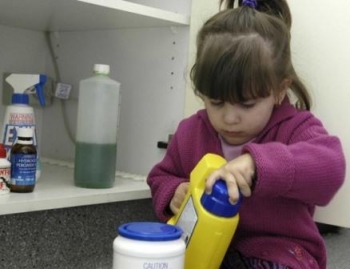
A child may not have time to lick or drink the substance, but gets their hands or face smeared with it. Drops can get into the eyes, and vapors into the respiratory organs.
Poorly rinsed laundry often causes allergies. The child breaks out in a rash or spots, starts sneezing, or has difficulty breathing, and parents do not even realize that it might not be from eating a mandarin, but from a new laundry detergent.
What then
which household chemicals are most dangerous?Poisoning by inhalation
Even the most pleasant-smelling substances can be dangerous for a child. This applies to air fresheners, which may contain potentially harmful compounds, including phenol and formaldehyde.
If a child gets hold of an aerosol can and opens it, they may not have the strength or ingenuity to press the valve (although they might try to taste it). However, if an automatic air freshener is used in the home, it is enough for the child to simply be nearby when the next dose of the substance is released into the air.
Chlorine-containing detergents and cleaning agents are even more dangerous. This is especially true when they are mixed with other products, due to ignorance or carelessness. Not only children, but the entire family can suffer. Chlorine is found in bleaches, toilet bowl cleaners, and other detergents. If the packaging says "contains chlorinol," it is practically the same as "contains chlorine."
If such a product is mixed with vinegar, chlorine will be released in gaseous form. This is deadly dangerous – chlorine was the first chemical weapon that killed and injured thousands of soldiers during World War I.
Also very dangerous are "thermonuclear" agents for removing stubborn dirt and grease. Despite their effectiveness, it is best not to use them at all if there are children in the house. Even with open windows.
Mixing different drain cleaners is extremely dangerous. The combination of some of them can cause a violent chemical reaction with splashing of corrosive droplets, or even an explosion.
Any solvents should also be reliably hidden from children, as there are no safe ones in principle.
Skin irritation
All detergents and cleaning agents must be thoroughly rinsed off with water to avoid contact with a child's delicate skin. A burn or severe irritation can occur if a child touches the edge of a bathtub or sink where a cleaning agent containing corrosive substances has been applied.
Even regular soap can be too harsh for sensitive skin and cause dryness and irritation. And if the soap contains strong fragrances, it can also cause allergies.
Do not blindly trust even the labels "baby" or "hypoallergenic." Sometimes it's just a marketing ploy.
The most
anionic surfactants (surfactants), as well as bleaching additives and enzymes are considered harmful. That is, precisely those components that ensure good washing of all kinds of dirt. So you will have to make a choice between effectiveness and safety. Or significantly increase rinsing time to wash away all potential harmful substances with water.In any case, before using the product, you must carefully read the instructions, do not exceed the recommended doses, and thoroughly wash and rinse all chemicals.
The fact is that children's skin does not perform its barrier function as effectively as adult skin. Harmful substances penetrate it more easily and can accumulate in the body. Therefore, an allergic reaction may not appear immediately, but after some time, when parents have already forgotten that they started using a new laundry detergent or dish soap.
Also dangerous are agents used to kill mold. They may contain formaldehyde and sodium hypochlorite, which have a toxic effect.
Frequent carpet cleaning with special agents can also cause poisoning, as these agents contain ammonium hydroxide and perchlorethylene, which have a pronounced irritant effect. In large quantities or with prolonged contact, these substances can damage the kidneys and liver.
Furniture polishes are also unsafe. They may contain nitrobenzene and the already mentioned phenol. These substances are easily absorbed through the skin upon contact and can harm the nervous system and respiratory tract.
Hand sanitizer, which is often found in a mother's purse or on a bathroom shelf, dries out the skin and often contains a lot of alcohol. Such products are not suitable for children's skin.
Mothers should constantly monitor that their child does not get into the cosmetic bag. Even high-quality cosmetics can cause allergies and irritation in a child upon contact with the skin. It's even worse if the baby tries to taste something, tempted by the scent.
Until the child grows up, all household chemicals and cosmetics should be kept out of their reach. And after using the necessary substances, thoroughly rinse and
rinse anything that came into contact with the chemicals.