Electricity and child safety
April 8, 2020
Modern life is impossible without electricity, but at the same time, it is always dangerous, especially for young children. Adults already possess basic safety rules due to their life experience, while small and active children explore everything around them with their senses and are just beginning to accumulate essential knowledge.
Modern life is impossible without electricity, but at the same time, it is always dangerous, especially for young children. Adults already possess basic safety rules due to their life experience, while small and active children explore everything around them with their senses and are just beginning to accumulate essential knowledge.
A child carefully examines everything around them, may pick up any object with their hands, lick it, or try to taste it. This is how a child gains life experience. However, human senses cannot detect electrical voltage on their own, and a child does not realize the full danger posed by electricity. Parents must ensure a safe living environment for their children and teach them to handle electrical appliances with caution.
To comply with these requirements, a differentiated and individual approach is needed, taking into account the age of the children. Children aged three to five are under parental supervision at home, and in preschool institutions, they are looked after by educators and teachers. For children's safety, it is necessary to maintain electrical wiring in good condition at home and block access to electrical outlets, various wires, and plugged-in appliances.
To achieve this, rubber dielectric plugs, which can be purchased at a store, should be installed. After installing plugs in the sockets, a child will not be able to insert ballpoint pens, small scissors, or other metal objects that conduct electricity.
Electrical outlets and switches at home must be securely fastened. Children should be denied access to plugged-in household appliances and the wires leading to them. A child might pull on an appliance cord or try to taste it.
Heaters, desk lamps, hair dryers, electric kettles, and other appliances are also not safe for children.
However, restricting access to electrical appliances is not the only way to protect children. The most important thing is to teach children the basics of electrical safety. Even at this young age, they are capable of understanding everything their parents tell them.
It is best to conduct such training in a playful manner, by showing educational cartoons for children and discussing the plots with the child. Group safety training sessions conducted by employees of preschool educational institutions also have a positive impact on children. Participation in such events gives children the opportunity to share their impressions with their peers, thereby forming an understanding of safe behavior in various situations.
Children older than five are given more freedom, their actions are less controlled, and they are allowed to go outside to play with their peers: rollerblading, ice skating, cycling. By this time, children should have formed a correct understanding of the dangers that electricity holds.
Children must know that electricity is a great threat. Under no circumstances should they climb power line poles, play there, or throw things at power lines.
Children love to fly kites outdoors, but adults need to choose open areas for such games as far as possible from power lines. The wind can tangle the kite in the live wires, which can lead to an electric shock.
Transformer substations and distribution cabinets can be found in almost all city courtyards. Children probably love to play hide-and-seek, but they should never hide behind electrical equipment. Children must understand this.
Children grow up, and first-graders become more independent. However, this independence requires a child to have a deeper understanding and skills for the safe use of electrical appliances at home and safe behavior outdoors.
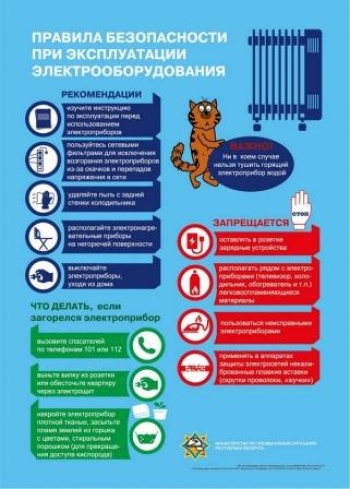
- When a child is alone in the apartment, they should know that they are not allowed to:
- • turn on electrical appliances without adults;
- • clean or open the protective covers of household appliances, or change fuses and light bulbs on their own;
- • touch electrical appliances plugged into the mains with wet hands.
If you smell burning insulation, you must de-energize the electrical appliance, but it is unacceptable to pull the power cord out of the socket.
Parents should constantly tell their children about all such situations. As the saying goes, repetition is the mother of learning.