From October 18 to 21, 2024, the State Automobile Inspectorate is holding the republican preventive campaign "Become More Visible in the Dark!" to prevent road accidents involving pedestrians and cyclists, and to promote the use of reflective elements and high-visibility vests.
October 18, 2024
For 9 months of 2024, 2475 road traffic accidents (hereinafter referred to as RTAs) were committed on the territory of the Republic of Belarus, in which 276 people died and 2759 were injured.
The highest mortality rate in road traffic accidents is observed as a result of pedestrian collisions. (27.9% of the total number of deaths in RTAs, or 77). 2/3 of pedestrian fatalities (66.2%; 51 out of 77) were registered in the dark.
Pedestrian collisions are one of the most common types of RTAs, resulting in serious health damage or even death.
A pedestrian is the most numerous road user, endowed with certain rights and responsibilities. Accident statistics show that there are many reasons for pedestrian collisions, but among the main ones are their failure to comply with the Traffic Rules, excessive self-confidence, and disregard for elementary safety measures.
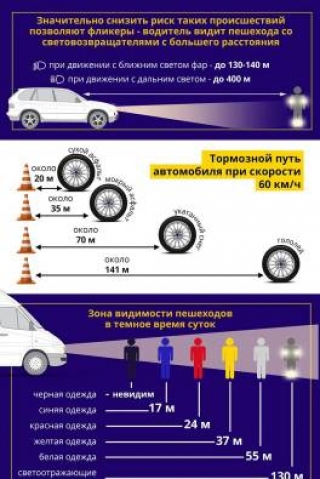
In autumn, people prefer to wear dark, non-marking clothes and walk along the roadway rather than on the shoulder, thereby putting their lives at risk from vehicles. After all, the laws of physics have not been canceled, and a driver who sees a pedestrian a few meters away does not have time to react and avoid a collision. Therefore, the use of reflective elements by pedestrians in the dark or in bad weather remains one of the effective ways to ensure their safety on the road. An identified pedestrian is visible in low beam headlights at a distance of 140-150 meters, and in high beam – 300-400 meters. And the driver has time to prevent a collision, i.e., to reduce speed and be more attentive. The pedestrian should place the reflector in the
where it will be clearly visible to drivers.The most dangerous categories of pedestrians are children, the elderly, and intoxicated individuals. If a driver notices any of these categories of pedestrians near the roadway, they must be prepared for the most unpredictable situations. The driver should try to attract the pedestrian's attention by flashing their headlights, honking, or even reducing speed and stopping. It is also very important to consider that on roads adjacent to populated areas, there is a high probability of pedestrians or cyclists suddenly appearing on the roadway.
To avoid traffic accidents, pedestrians should walk on sidewalks, pedestrian or bicycle paths, and where these are absent, along the shoulders. In places where the aforementioned road elements are missing, pedestrians may walk on the roadway facing oncoming traffic to see approaching vehicles and yield to them in a timely manner. In such cases, pedestrians should walk as close to the edge of the roadway as possible to occupy minimal space.
Pedestrians must cross the roadway at pedestrian crossings. In the absence of these at intersections, they should proceed along the line of sidewalks and shoulders, ensuring that entering the roadway is safe. If marked pedestrian crossings and intersections are not visible, pedestrians should cross the roadway in a section that is clearly visible in both directions and along the shortest trajectory.
It should not be forgotten that cycling on the road during darkness or in conditions of insufficient visibility is equally dangerous. It is worth reminding that bicycles must be equipped with a headlight emitting white light at the front and a taillight emitting red light at the rear. Outside populated areas, cyclists must wear high-visibility clothing with reflective elements.
For violating the rules, a pedestrian may be held administratively liable in the form of a fine ranging from 1 to 3 base units. The same actions committed by an intoxicated pedestrian will result in a fine of up to 5 base units.
The State Automobile Inspectorate urges citizens not to remain indifferent and to report instances of intoxicated pedestrians or cyclists on the road, whose behavior is unsafe and requires immediate measures to remove them from the roadway, by calling 102.