Ice Safety Rules
December 23, 2020
Ice is one of those wonders that comes with winter. It brings the joy of ice skating, the tranquility of ice fishing, and, unfortunately, sometimes injuries and life tragedies.
Ice is one of those wonders that comes with winter. It brings the joy of ice skating, the tranquility of ice fishing, and, unfortunately, sometimes injuries and life tragedies.
Children have a particular interest in this natural phenomenon. A child looks for a toy everywhere, and ice is a fascinating amusement for them, which they can enjoy for only a couple of months a year. Another category of people who are passionate about this season are fishermen, who, with the onset of cold weather and in spring, practically play Russian roulette every time.
Rescuers recommend not to risk your life at all and to go on the ice only at an ice rink, and to fish only from the shore of a lake. But if you cannot do without winter hobbies, then observing the following safety rules is a mandatory condition.
Determining danger by color:
- the strongest ice is transparent blue. Remember Lake Baikal: roads are laid across the frozen lake annually;
- weak ice is opaque white. It is half as reliable;
- brittle ice is gray and gray "speckled". When on such a surface, the chance of having an extreme catch is too high;
- it is important to know: at a temperature of 0°C, maintained for three days, the strength of the ice decreases by 25%.
Unsafe Places
Safe ice is at least 10 cm thick, but even if you are meticulous, have a tape measure with you, and the ice is, for example, 11 cm, this is not a guarantee of safety: you need to walk on it carefully. And in river mouths, channels, places with fast currents, springs, and drainage waters, as well as in areas where aquatic vegetation grows, near trees, bushes, and reeds, the ice strength is weakened, and these places should be avoided altogether.
When there will be no bite
At night, the bite may be better, but it is worth remembering that in the dark, a person's chances of becoming "catch" of the lake or river themselves increase.
First, if you fall through the ice, it will be much harder for you to get out. Second, lost evening travelers, even if they heard calls for help, may simply not notice you. You should also refrain from fishing in poor visibility – during fog, snowfall, rain, and especially blizzards.You can check the ice for strength not only visually. But this must also be done correctly – not by kicking or jumping, but, for example, with a simple stick. If water appears when tapping, then you should not walk on such ice.
In a trap
If it so happened that you found yourself trapped or realized that the ice is too thin everywhere, and it is better to postpone fishing for later – make your way back to the shore along your tracks. Try to distribute the load of your body over as large an area as possible. Do not rush, take sliding steps, without lifting your feet off the ice, imagine yourself as Darya Domracheva, and reach the shore. Similar rules apply when you have to cross a body of water.
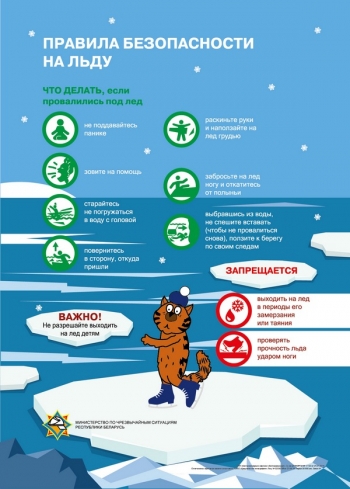
If you fall into the water:
Do not panic. Rescue depends 90% on the confidence and psychological state of the person who fell into the water. If there are people nearby, call for help. Try not to go underwater with your head. Move towards the edge of the ice hole from which the current is coming. Having reached it, try to lean your chest on the edge of the ice and, throwing your leg, get out onto the ice. Even if the ice breaks, do not give up trying to get out. When the main part of your body is on the ice, crawl or roll away from the ice hole. Slowly and carefully crawl to a safe place, return back along your tracks.