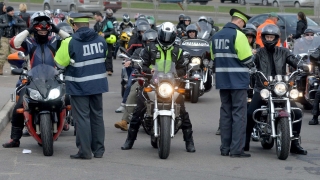
From April 27 to May 4, a republican preventive campaign called "Motorcyclist!" is being held on the territory of the Republic of Belarus.
April 26, 2024
During the preventive event, traffic police officers will carry out effective control daily during traffic supervision over compliance by motorcyclists with the Traffic Rules, other legislative acts in the field of road traffic, including in the form of mixed control.
During the preventive event, traffic police officers will carry out effective control daily during traffic supervision over compliance by motorcyclists with the Traffic Rules, other legislative acts in the field of road traffic, including in the form of mixed control.
In the current year, 6 accidents involving motorcyclists have already been recorded in the Vitebsk region.
For reference: A motorcyclist was injured in the Polotsk district
The accident occurred on March 31 on the N17234 highway. According to preliminary information, a 45-year-old driver, driving an "Alpha" moped, lost control, drove into the oncoming lane, where he fell onto the roadway. As a result of the accident, the motorcyclist received bodily injuries and was taken to a healthcare facility.
Basic safety rules for operating a moped (scooter), motorcycle!
Motorcycle owners underestimate the danger of this type of transport.
A scooter driver is a full participant in traffic who is obliged to know and comply with all the requirements of the Traffic Rules. To operate a scooter, a driver's license of category "AM" is required, and the moped must be registered with the traffic police. To ensure safety, it is forbidden to ride a scooter without a fastened motorcycle helmet.
It should be noted that the speed of a scooter is significantly lower than other vehicles on the road, which means that in order not to interfere with other road users, you can ride a moped
not more than 1 meter from the right edge of the roadway. In this case, moving more than 1 meter from its right edge is allowed only for bypassing an obstacle and, in permitted cases, for turning left or making a U-turn. Thus, being off to the side of the main traffic flow, the moped driver is himself in greater safety and does not impede anyone. This requirement must be strictly observed also because a scooter rider is much less protected from injuries in the event of an accident. Like any vehicle, a scooter must be operated only in technically sound condition, without any modifications. The Traffic Regulations also define a number of other prohibitions for moped or scooter drivers, namely:– it is forbidden to ride without holding the handlebars and (or) without keeping your feet on the footrests, as in such a riding position you cannot fully control the scooter's behavior and will not be able to react in time to the changed road situation;
– on a road with a tram track, and on a road with more than one lane in the current direction, it is forbidden to turn left or make a U-turn;
– it is forbidden to carry passengers on a moped, unless provided for by the moped's design; if a designated seat is available, the passenger must be over 12 years old;
– it is forbidden to carry cargo that extends more than 0.5 meters in length or width beyond the dimensions of the vehicle, as well as cargo that interferes with the control of the vehicle;
– moped drivers are prohibited from riding on sidewalks, bicycle paths, pedestrian paths, and bridle paths.
At the same time, moped owners should remember the mandatory daytime use of low beam headlights. It will not be superfluous to wear a high-visibility vest or clothing with reflective inserts. This will make you more visible to other road users.
10 Rules for Safe Motorcycle (Moped, Scooter) Riding
Situational awareness. Always try to control your surroundings, regularly glance in your mirrors, listen to what is happening around you, and turn your head.
Speed limit. Ride at a reasonable speed – do not exceed the flow speed by more than 15-20 km/h. In stationary traffic jams, ride slowly between lanes and be ready to stop immediately – sometimes cyclists and pedestrians, who are not visible behind cars, cross stationary traffic jams, and car doors suddenly open, etc.
Road condition. The road surface — be especially careful when crossing road markings — they are raised and slippery, especially when wet. Sand and gravel on the road can cause a fall when hit, and if there is spilled gasoline, diesel fuel, or oil — tire grip drops as if on ice.
Equipment. Always try to ride in full protective gear — helmet, gloves, jacket with protection, pants with protection, shoes with protection. When riding with an open visor, beware of sand or insects getting into your eyes.
Visibility on the road. Always ride with low beams on, in some cases, when there is no glare from oncoming traffic (e.g., on a bright sunny day) — high beams can also be used. An orange or yellow "traffic" vest worn over a motorcycle jacket, as well as brightly colored clothing and motorcycle, and reflective elements on clothing — will not hurt.
Blind spots. Avoid staying in one position for too long, especially if there is a possibility that you are not visible to someone in their mirrors. In doubtful situations, do not hesitate to "roar" the engine, honk, flash your high beams to signal your presence.
Smooth control. Avoid braking and accelerating when passing through difficult, slippery areas — sand on the road, gravel, crossing road markings, railway tracks. If possible, try not to brake in a turn, cross railway tracks at a right angle if possible and on an upright motorcycle. If you see sand or other hazards in a turn — if possible, straighten the motorcycle before passing through it, or at least maximize the turning radius while reducing speed. Before entering a hazardous area, you should have "steady throttle" — without slowing down or accelerating.
Situation. Look not only ahead but also at the overall situation. A common mistake of novice drivers, especially in city traffic, is to look only at the car in front. As a result, when it starts to brake, it is an unexpected event for them, although if they looked around, they would see that 3-4 cars ahead — the entire lane — is slowing down, and they would also start to slow down in time and be ready for braking/maneuvering. Control intervals (gaps on the sides) and distances (distance to the vehicle in front and behind). Do not get too close to the vehicle in front; the distance should be at least 2 seconds, and preferably 3-5 seconds.
Night riding. Exercise particular caution when riding
at night — visibility is significantly reduced; if the road runs near a forest — various animals may cross or run across the highway, which can be seen too late. Reduce your speed to a safe level — ideally, you should be able to stop within a distance shorter than the visibility range. Do not forget that people in a state of severe alcohol intoxication may be on the roads, and vehicles and tractors may be left on the roadside or elsewhere without lighting, etc.
Never rush. Never, under any circumstances, rush anywhere, except in extreme cases — when life or death literally depends on speed. A meeting, even a very important one, being late for work, etc. — they are not worth it. It is precisely because of rushing that most accidents occur. No one will die if you are 2, 3, or 5 minutes late, but it is more than possible to end up in the morgue due to speeding; dozens, hundreds prove this every year. Remember — your loved ones are waiting for you at home…
Only you have the power to prevent tragic consequences of road traffic accidents caused by operating a motorcycle. If you observe traffic violations by motorcycle drivers, report them immediately by calling 102.