Slow down – save a life!
June 27, 2024
One of the most important aspects of driving is choosing a safe speed.
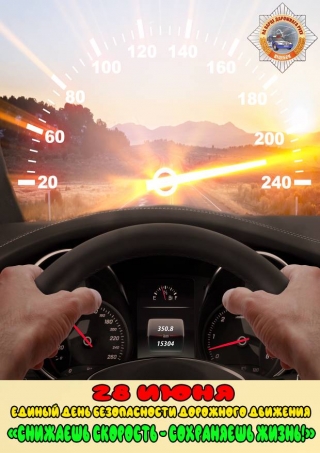
On June 28, 2024, the
Unified Road Safety Day
"Reduce Speed – Save Lives!"
(Prevention of traffic accidents due to speeding)
One of the most important aspects of driving is choosing a safe speed. The general rule for driving around "blind" corners, at intersections with poor visibility, and on narrow streets is as follows: the speed should be such that the car's braking distance is less than the visibility distance. This recommendation is especially important in adverse weather conditions: dense fog, snowfall, and rain, as well as at night.
Stopping Distance. There is a special formula for calculating braking distance based on vehicle characteristics and road conditions. However, it's not just about braking distance, but also about the so-called stopping distance, which is the braking distance plus the driver's reaction time. Consequently, the stopping distance is always greater than the braking distance. Furthermore, a safe driving speed often depends on many subjective factors.
For example, in warm weather on dry asphalt at a speed of about 40 km/h, the braking distance is 8 meters. Accordingly, 1-2 seconds for the driver's reaction should be added to this. This adds several more meters. In addition, other factors should not be forgotten.
Subjective Factors. Suppose a car is driving down a narrow alley at the same 40 km/h, and a person suddenly appears just 5 meters ahead. A similar situation occurs when driving on a road with many parked cars, where a door suddenly opens in one of them. Where is the guarantee that the braking distance will be sufficient to prevent a tragic situation? And it's not a given that there will be enough free space to swerve sharply and avoid the obstacle.
From the examples provided, it is easy to understand that
safe driving speed is the speed dictated by the specific road conditions. And with rare exceptions, it is better to drive slower than indicated by road signs. In addition, there are very specific features of driving a car in the city and outside the city, when driving in traffic, passing through a residential area, etc.In traffic. In dense traffic it is advisable to move at its speed, but it is permissible to be 10-15 km/h faster or slower. And this difference must not be violated, i.e. driving faster-slower by 20 or more kilometers per hour. Otherwise, the car will hold back other road users, they will be forced to constantly overtake you. And during maneuvers, cars create a lot of blind spots, and this heats up the traffic situation.
In addition, one of the conditions for safe driving is free space. No matter how experienced the driver is, the probability of getting into an accident when driving in dense traffic still increases. In addition, not 2 cars, but more can get into an emergency situation. Therefore, good lateral clearance helps to avoid accidents, allowing you to change lanes and drive around crashed cars. And in general, it is better to avoid driving in conditions of mass vehicle congestion and choose sufficiently free sections of the road.
Rural highways. Outside the city it is allowed to drive at a speed of 90-110 km/h, so the speed of driver reaction has a special impact on driving safety. Therefore, the further he sees, the more seconds remain to make the right decision. However, it should be taken into account that with a high driving dynamic, the driver's field of vision narrows, and objects on the sides merge, they are practically indistinguishable. Of course, the driver tries to combat this effect and tries to control the roadside, read signs. All this leads to the fact that his attention when driving on the highway at a speed of 120 km/h is focused on a distance of about 150 m, and the reaction time increases significantly. And it should be taken into account that with such a driving dynamic, the braking distance will be over 110 m.
If something unexpected happens in such conditions, the driver will need at least 2 seconds to react to the situation. One second is spent on decision-making, the second - on manipulating the steering wheel and brakes. During this time, the car travels about 50 m, i.e., the stopping distance is 160 meters or more. Accordingly, the safe speed
outside the city is considered to be no more than 110 km/h. The reason is the increased concentration of the driver, which quickly leads to fatigue, negatively affecting their ability to control the situation on the highway. In general, it is better to drive slower, i.e., more safely.In the city. Every driver knows that it is permissible to drive on city roads at a speed of 60 km/h. Drivers rely on the good characteristics of modern cars, they are quite confident that if necessary, they will be able to slow down in time.
Of course, on wide and long avenues, such an opportunity exists, while on narrow roads, which also constantly wind around residential areas and other sections, visibility rarely exceeds 40 m. And even when driving on dry asphalt at a speed of 80 km/h, the braking distance will be 42 m, plus a few meters will be added while the driver reacts to the situation. Therefore, it is better not to take risks. And it is highly desirable not to exceed the speed limit in the city of 60 km/h, because when observing it, the braking distance is 23 m. Accordingly, a difference of 19 m significantly increases safety. Surely such a distance gain has repeatedly saved someone's life and allowed to avoid significant financial damage in the form of a car damaged in a road traffic accident.